Vaillant F23 Fault Code: What It Means & How to Fix It
The Vaillant F23 fault code means the temperature gap between the boiler’s flow and returns pipes is too wide. The boiler will automatically turn off to save itself, typically due to disturbed flow of water. The code indicates what the boiler has detected, but not the cause, which is the part you need to find when an F23 Vaillant lockout leaves the radiators cold. In some cases, it’s due to a closed valve that can be fixed, or trapped air that can be resolved easily by homeowner, but in other cases if it’s a worn pump or a sensor failure that must be addressed by an engineer.
Working out which one you have before you act avoids repeated resets and parts you didn’t need. In this guide, we cover what F23 means, what causes it, which checks are safe to try, how to reset the boiler, and when to call a Gas Safe registered engineer.
What does the F23 fault code mean on a Vaillant boiler?
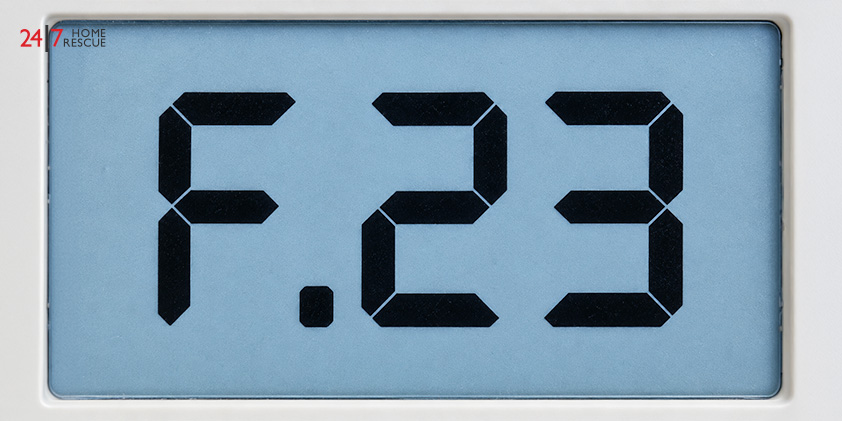
A Vaillant F23 fault code indicates that there is a circulation fault on your boiler. The boiler has turned off due to the water not flowing correctly.
The flow pipe circulates hot water from the boiler to the radiators. It is circulated back through the radiators in the return pipe in a cooler state. The temperature difference (Delta T) of the two is measured by the flow and return NTC sensors (thermistors) on the boiler. Under natural flow conditions, the extent of spread remains small. As circulation decreases, the flow pipe becomes hot and the return pipe cools and the boiler will shut down when the temperature difference exceeds the limit, which is typically around 35°C.
| What to compare | Normal running | F23 fault |
|---|---|---|
| Water circulation | Normal | Slow or blocked |
| Temperature spread (Delta T) | Small | Too large |
| Boiler | Keeps heating | Shuts down and shows F.23 |
| Radiators | Heat up evenly | Stay cold or heat unevenly |
Is F23 on a Vaillant a pressure problem?
No. F23 is not a low-pressure fault. Low pressure on a Vaillant shows F22, a safety switch-off that appears when system pressure drops too low. F23 appears when the flow and return temperatures are too far apart because water is not circulating properly.
F23 is indirectly affected by the pressure. The sooner a system has lost water, the more apt it is to contain air, and air impedes circulation. F23 is triggered by the temperature gap, not the pressure reading. It can cause it to lock out because of the temperature difference between the flow and return pipes, and even a boiler with a normal gauge may lock out. If it displays F22, it is due to low pressure, and the Vaillant F22 error code solution is different. If the pressure keeps dropping and you can’t find a leak, a boiler losing pressure can let air into the system, which can then lead to F23.
What causes the F23 fault on a Vaillant boiler?
An F23 boiler fault is almost always caused by poor water circulation, and sometimes by a faulty sensor. The table below shows each cause, what to look for and whether you can check it yourself.
| What you see | Likely cause | DIY or engineer? |
|---|---|---|
| Radiators cold at the bottom, hot at the top, and dark water when you bleed them | Magnetite sludge | Engineer |
| The boiler fires but the radiators stay cold, and the pump is silent, or noisy and struggling | Weak, stuck or wrongly set pump | Engineer |
| Gurgling and cold patches at the top of radiators | Trapped air | DIY: bleed the radiators |
| Some radiators stay cold | Closed valve (lockshield or boiler isolation) stopping flow to part of the system | DIY: check the valves are open |
| Radiators heat normally but F23 keeps returning | Faulty flow or return NTC sensor | Engineer |
| Weak flow, and the magnetic filter has not been cleaned for years | Blocked filter | Engineer |
Which radiators stay cold points to the cause:
- All radiators cold or slow to heat pump, sludge or filter.
- Only some radiators are cold: closed valves, or air in those radiators.
- All radiators heat normally: sensor or its wiring, and a Vaillant F72 fault code on the display points the same way.
How do you fix a Vaillant F23 fault? Step by Step Process
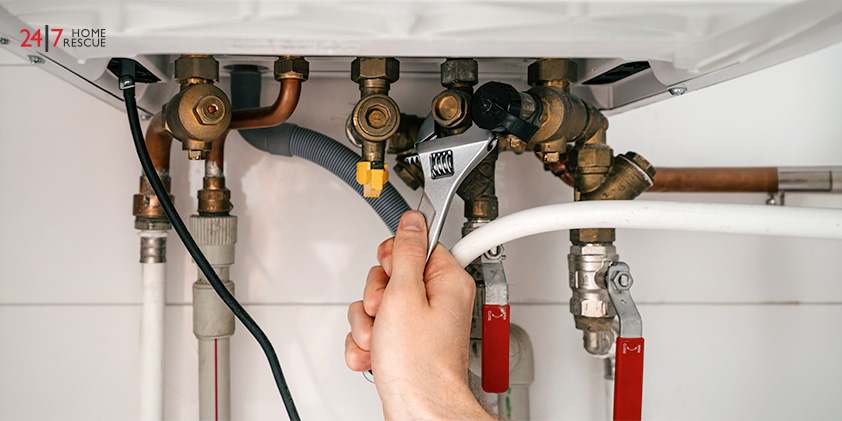
There are four steps to resolve an F23 fault on a Vaillant boiler that does not require the casing to be opened. Work through them in order and stop if F23 returns.
Step 1: Note the code and reset the boiler once
Write down the code on the display, then reset the boiler once. A temporary airlock or one-off temperature increase might be caused as F23 clears. If the code returns after the reset, go on to step 2 but not reset again.
Step 2. Check the boiler pressure when cold
Check pressure gauge when the boiler is cold. It should be between 1 and 1.5 bar. If it is below 1 bar, top it up with the filling loop until it reaches 1 bar, then check whether it drops again. Topping up will not clear F23 by itself, but low pressure can mean air has entered the system.
Step 3. Bleed any radiators with cold spots
Bleed any radiator with a cold patch at the top. Switch off the heating and let the radiators cool down. Open the bleed valve with a radiator key until water comes out instead of air, then close it. Do one radiator at a time, then check the pressure and top it up if needed. If a radiator is still cold after bleeding, air is not the cause.
Step 4. Check the radiator and isolation valves are open
Ensure all radiator valves, lockshield valves and under the boiler isolation valves are open. On a quarter-turn isolation valve, the handle is open when it lines up with the pipe. If a valve is stuck, don’t force it. If a valve is stuck, don’t force it, call an engineer.
After these four steps if F23 still appears then book a Gas Safe registered engineer. If you smell gas, evacuate any premises and contact the National Gas Emergency Service on 0800 111 999. Never take the boiler casing off.
How do you reset a Vaillant boiler showing F23?
If your Vaillant boiler shows F23, press and hold the reset button on the display for one to three seconds, depending on the model Only reset once as repeated resets would add additional pump and heat exchanger load.
- Find the reset button. On Vaillant ecoTEC boilers it is on or just below the display.
- Press and hold it. Vaillant’s reset guidance says to hold it for about three seconds and to check your manual, because the time varies by model. Some ecoTEC models need only one second.
- Check the display. F.23 should clear, and the boiler should restart within a few minutes.
- Do not reset again if F23 returns. Book an engineer instead.
A Vaillant F23 fault code reset only clears the display.
Why does the Vaillant F23 fault keep coming back?
The Vaillant F23 fault continues to recur as the fault code is wiped after a reset, but the cause of the fault remains. The cause of the slowdown, whether it’s sludge or a weak pump or a faulty sensor, remains, which means the water temperatures of the flow and returns separate again after the heater has been in operation for a while.
How soon F23 returns can point to the cause:
- Within the same day or heating cycle: circulation problem remains, typically a weak pump or a blocked flow.
- After days or weeks: sludge can get back up or the sensor or its wiring is switching on and off.
If the F23 code returns after resetting and completing the four checks, schedule an appointment with a Gas Safe registered engineer. A boiler repair visit records the flow and returns temperatures, tests the pump and sensors and determines the cause, so the right part gets fixed.

Boiler Repair
Book your boiler repair online and save time and effort. Our certified engineer will provide you with hassle-free assistance.
What does a Gas Safe engineer check on an F23 fault?
Each component in the circulation system is tested one by one by a Gas Safe registered engineer before they begin to repair anything. On the visit they work through the checks mentioned below.
- Flow and return readings: taken with the boiler running, to see how big the gap is and how fast it grows.
- Pump: check if the pump speed setting is correct for the system, and if the flow rate of the pump is sufficient.
- Flow and return NTC sensors: test the readings and check the wiring and connectors for damage or loose fittings.
- System water and filter: tests the water for sludge, monitors, and cleans the magnetic filter to determine if magnetite is causing water to back up.
- Bypass: on system and heat-only boilers test the bypass setting as a bypass allows water to continue flowing through the boiler in the event of the radiators shutting off.
How do you stop the Vaillant F23 fault coming back?
To prevent the Vaillant F23 fault from recurring, ensure the water that is pumped through the system is kept clean and flow is maintained at a regular pace. The steps below guide you on how to stop the Vaillant F23 fault code from coming back.
- Annual service: An annual boiler service enables an engineer to identify wear before it locks the boiler out.
- Magnetic filter: It will remove magnetite from the system before it can circulate around the system, and it is cleaned during every service.
- Inhibitor: a liquid that is poured into the system water to reduce the corrosion rate which forms magnetite sludge.
- Balanced radiators: an engineer balances the valves so every radiator gets its share of hot water and none is starved.
- Power flush: this clears sludge from the pipes and radiators, but it does nothing if the pump or a sensor is the cause.
These steps reduce the risk of F23 reoccurring but cannot eliminate it as there is always a possibility of failure of the pump or sensor.

Boiler Service
Ensure your boiler runs efficiently and safely with our professional boiler servicing. Regular maintenance will save you money in the long run and potentially prevent breakdowns.
What should you do about a Vaillant F23 fault?
A Vaillant boiler F23 fault indicates that the flow and return temperatures are not within correct limits, usually due to inadequate circulation and not to low pressure. It is possible to reset the boiler one time, check the pressure, bleed radiators with cold spots, and make sure the valves are open. If F23 comes back after that, then the cause is still in the system and needs a proper diagnosis.
That is where 24|7 Home Rescue can help. Our boiler repair is the fix when the cause is still in the system, because a Gas Safe registered engineer finds it and repairs it, with parts, labour and VAT included in the price. Call our helpline for any boiler fault and add boiler cover to be protected if it breaks down again.

Boiler Insurance You Can Trust
Get boiler breakdown and landlord cover including free annual boiler service.
Choose your policy type
Frequently Asked Questions
Can I fix a Vaillant F23 fault myself?
There are four safe checks you can make: reset the boiler once, check the pressure, bleed radiators with cold spots and make sure the valves are open. If F23 comes back after these steps as well, there can be a problem with the pump, a sensor, sludge, or the filter. A Gas Safe engineer should check it out. Never take the boiler casing off.
Can a faulty sensor cause F23 when the radiators are fine?
Yes. If the radiators heat normally but F23 keeps returning, the flow or return NTC sensor or its wiring may be sending a wrong reading. However, the boiler experience a large temperature difference even as the water circulates. The sensor readings and wiring are tested by the engineer to ensure accuracy.
How much does it cost to fix a Vaillant F23 fault?
The cost depends on the cause of the fault. An engineer bleeding the radiators can cost around £100, replacing a flow or return sensor may cost about £80 to £230, a new pump might be £150 to £400, and a power flush, which only helps if sludge is the cause, could cost about £300 to £700. Prices vary with your boiler, system, and location. With 24|7 Home Rescue, boiler repair prices include parts, labour, and VAT on accepted repairs, subject to terms and conditions.
Does boiler cover or a Vaillant warranty pay for an F23 repair?
It depends on your policy. Many boiler policies include repairs, but some have an excess or leave certain things out, so check your policy before you book. A Vaillant warranty covers faults in the boiler itself, and you usually need to have the boiler installed and serviced as the terms say. Check your warranty terms and keep your service records.
Can I still use my Vaillant boiler with an F23 fault?
An F23 Vaillant boiler has locked out as a safety switch-off, so it stops heating until you reset it, and a combi usually stops making hot water too. If one reset brings it back, it will run, but F23 is likely to return while the cause is still there. Book an engineer instead of resetting it again.
Will a power flush fix a Vaillant F23 fault?
A power flush fixes F23 only when heavy sludge is the cause. An engineer checks the system water and magnetic filter first, because a flush is a bigger job and has no effect on a pump or a sensor fault. If sludge is confirmed, a filter and inhibitor afterwards keep it from building up again.
Does an F23 fault mean I need a new Vaillant boiler?
Usually not. F23 is caused by a circulation fault and both faults can be fixed on most boilers. The boiler should only be replaced if it has reached a very old age, the heat exchanger is damaged or repairs are recurring, and an engineer can confirm that.
At 24|7 Home Rescue, we aim to keep our blogs accurate and helpful at the time of publication. However, details such as images, services, prices, offers, discounts, or related information may change over time. Content is provided for general information only and should not be taken as professional advice. For appliance- or boiler-specific guidance, always refer to your manufacturer’s user manual, as controls, settings and features may vary by brand and model. For the latest updates on our services, prices, and any available offers or discounts, please review our Terms & Conditions or contact us directly. 24|7 Home Rescue accepts no liability for any actions taken based on outdated or incomplete content. Our team is always happy to help with any questions.
Recent Posts
Popular Posts

24 Mar, 2015


13 Apr, 2015